Acupuncture Services
Acupuncture and Traditional Chinese Medicine (TCM)
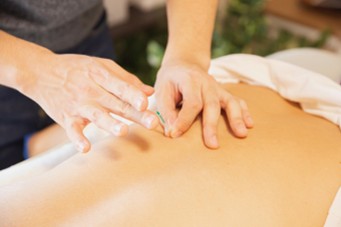
All of our acupuncture services are priced as follows.
Individual Acupuncture Sessions
Initial session: $165.00
Subsequent sessions: $135.00
Constitutional Facial Acupuncture
Single Session: $250.00
For an extensive list of health conditions and corresponding TCM treatments, refer to the Western Condition to Eastern Diagnosis Matrix.
_______________________________________
Treatment Style/Type
Acupuncture
Acupressure
Auricular Acupuncture
Original Authentic Dry Needling
Chinese Acupuncture
Esoteric Acupuncture
Five Element Acupuncture
Japanese Acupuncture
Korean Acupuncture
Oriental Medicine
Qi Gong Energy
* Includes Chinese dietary guidelines & therapy, dietary supplements and vibrational supports
Please refer to this list for Turning Point Specialties, Expertise and Treatment Techniques.
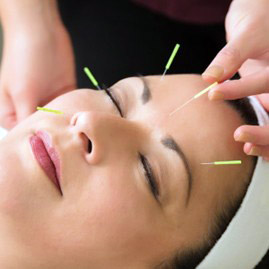
Facial Acupuncture
To learn more about facial acupuncture, please refer to the article The Face: A Portrait of Qi.
The Face: A Portrait of Qi
Published in Acupuncture Today
July, 2008, Vol. 09, Issue 07
Authored by Dr. Susan Russell
Contributing Editors: Mary Elizabeth Wakefield and MichelAngelo
Auricular Acupuncture
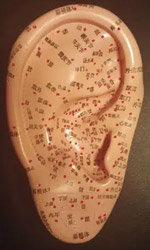
Auricular acupuncture is part of acupuncture. The ear has a deep microcirculatory network with innervation extending throughout the ear capable of balancing systemic health. Within the compendium of acupuncture, the ear like other parts of the body acts as a microsystem that reflects the entire body.
Licensed acupuncturists often stimulate specific points on the ear either alone or in conjunction with other acupuncture points to treat a variety of systemic conditions, including metabolic disorders, pain, and even psychological issues.
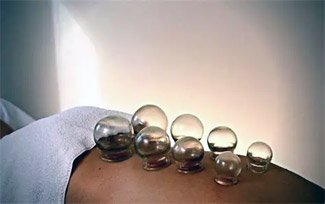
Cupping
Cupping is a deeply valuable adjunct therapy rooted in acupuncture based on understanding the science of circulation and issues when circulation is blocked or congested. I prefer to use glass or bamboo cups. The cup may be left in one place or moved slowly over aching muscles for 10-15 minutes. This treatment is not painful and feels similar to deep massage work. The therapy is soothing, providing immediate relief from body aches and pains.
Cupping is also excellent for trimming the waist and flattening out the tummy. As circulation increases and dampness dissolves, the body begins to heal itself. Each of us is exposed to many toxins on a daily basis from the air we breathe, the food we eat, the paper and plastic we touch and the environment we live in. Cupping, along with acupuncture, proper diet, and exercise, is extremely useful in maintaining good health and avoiding colds and flu. It can be performed on a regular basis alone or as part of detoxification. Once deeper circulation improves, the body will feel light and healthy once again unencumbered by stagnation and sluggishness.
Cupping warms the body and promotes the free flow of Qi (energy) and blood in the body and contributes to alleviating circulatory disorders. Symptoms of these disorders are felt as pain caused by stagnation of Qi and/or blood, and numbness or tingling in the extremities. Cold hands and feet, menstrual pain, musculoskeletal disorders and headaches are all examples of disorders caused by a stasis of Qi or blood in the body. If left untreated, this interrupted flow of Qi and blood in the meridians can lead to more serious ailments. Furthermore, cupping can be used preventatively to increase circulation, balance energy in the body, and stimulate immune function.
Cupping dispels cold and dampness in the body, two main causes of pain and illness. For example, a weak patient or someone recovering from illness may be more susceptible to a cold invasion. Cold inhibits the free flow of energy in the body leading to pain, stiffness and/or illness such as nausea, vomiting, diarrhea, numbness, lethargy, and runny nose.
Dampness accumulates in the body because of a weak digestive system, lack of exercise, and/or an unhealthy diet. This manifests as a feeling of heaviness in the morning, general fatigue, or shoulder and neck tension. Cupping, acupuncture, and dietary changes can restore healthy digestive function, and symptoms of nausea, loose stools, and bloating disappear. Perhaps the most widely used function of cupping is to diminish pain and swelling. It is extremely effective for relieving pain syndromes of the neck, shoulders, and back. This technique brings deep, old injuries to the surface so the body can more easily release them. Old injuries have often worked themselves into the deeper musculature of the body, causing stiffness and pain, especially in the morning. Patients experiencing muscular tension can experience great relief from 10-15 minutes of cupping before any acupuncture needles have been placed.
Cupping is excellent for health maintenance as it creates a pathway for the body to rid itself of toxicity by enhancing momentum in circulation. The increase in the momentum of circulation means the body has renewed power to push these toxins into the lymphatic system for appropriate drainage.
Acupuncture and TCM
TCM (Traditional Chinese Medicine/ Classical Chinese Medicine) incorporates acupuncture and has been around for thousands of years dating back to early Chinese communities. Where communities form there are people, where there are people there are accidents, illness and natural disasters that disturb daily life. Chinese practioners developed remedies and acupuncture emerged to meet these demands. Did you know that nearly 60% of the world’s populations consider some form of TCM and Acupuncture as their primary treatment. Acupuncture continues to have many applications in our modern times providing a level of energetic nourishment of the body’s innate healing potential. Sealed documents from a tomb in China dated from 198 BCE mention meridian energy systems within the body. A text titled: The Yellow Emperor’s Classic of Internal Medicine, dating from about 100 BCE. includes detailed knowledge regarding the concepts of channels (meridians or conduits in which the Qi flows. Between the 14th and 16th centuries the Ming dynasty flourished (1368–1644). The Great Compendium of Acupuncture and Moxibustion emerges replete with principles of acupuncture that remain as integral to TCM today.
A contemporary recognition of the depth of knowledge contained within the system of acupuncture has been described as follows:
“..the human body is a microcosm or small space-time field within a larger field. If we can maintain this view, we can recognize that acupuncture is one of the first empirical demonstrations of biological scaling within the universe.” – Hurtiak The Book of Knowledge: The Keys of Enoch (Los Gatos, CA.: The Academy For Future Science, 1977), 57.
Does acupuncture hurt? There is a slight prick and pressure that passes quickly.
Additionally, according to Chinese medicine, when there is an imbalance in the body it is manifest somewhere in the system, the brain is no exception. Psychiatric conditions such as Attention Deficit Disorder, Bipolar states, Psychosis and Schizophrenia, for example are not seen as dis-ease states but rather these conditions are viewed as imbalances that can be corrected by balancing the appropriate Zang-Fu pair or pairs of organs.
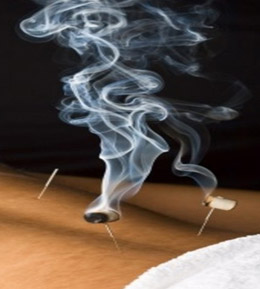
Moxa – The Mystery Revealed
Ancient Chinese teachings have been known to use Moxa for the following uses/conditions:
- Warms the Meridian Channels
- Dissipates cold
- Relives pain
- Moves “Qi”
- Reinforces Yang Qi
- Moves (Enlivens) blood
- Warms the uterus
- Stops excessive bleeding in women
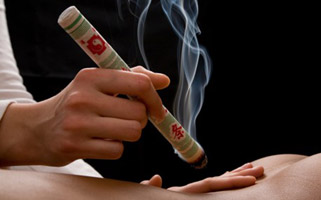
What Is Moxa?
Moxa is an herb known as mugwort. It is generally harvested in the early part of the summer. The leaves are dried and aged and can be crushed and/or sifted. The highest quality Moxa comes from the underbelly of the leaf. This type is usually reserved for direct application to the skin. The less refined Moxa is a blend of the fluffy underbelly of the leaf with some of the main leaf parts. This blend of Moxa is always used in “indirect” non-contact moxibustion.
Moxa generally burns slowly, and its heat gently penetrates the meridian channel, to move the “Qi” and Blood. Moxa’s odor is “musty” and generally produces a large amount of smoke. This smoke can remain in clothes and hair for a long period of time, so it is recommended that good ventilation be available.
Loose Moxa is used in the form of “cones” to wrap around acupuncture needles. There are also thick and thin sticks of Moxa. Moxa may also be burned on salt, garlic, or ginger on the body in various places for specific applications or treatments. When it is directly held over acupuncture points it is carefully rotated in order to not come into close contact with the skin.

Clinical Moxa
The three most common forms of Moxa used in clinics are:
- Moxa punk – loose moxa (this is what I generally use in my clinic).
- Smokeless moxa sticks – similar in appearance to a charcoal stick.
- Moxa roll – cigar-shaped cylinders